Backlinks are becoming proof, not just votes
A practical way to think about backlinks in the AI-search era: build a public trail that proves what your project is, where it lives, and why it deserves to be found.
The old backlink metaphor is a vote. One site points at another site, and that point counts as confidence. It is a useful metaphor, but it also makes people behave strangely. They start looking for votes anywhere they can get them. They count links. They chase domain authority. They forget that a link is also something much simpler: a public piece of evidense.
That is the more interesting way to think about backlinks now.
A backlink says: this project exists here, in this context, with this name, attached to these people, topics, products, and claims. Sometimes it passes authority. Sometimes it is nofollow. Sometimes it is just a profile field on a community site. But it still helps create a public trail that search engines, AI search tools, journalists, partners, and real humans can inspect.
If backlinks used to be mostly votes, the better mental model today is proof.
The web is full of claims without witnesses
Every new product can publish a homepage. Every consultant can write an expertise page. Every SaaS can say it is trusted, fast, secure, loved by teams, and built by experts.
That is cheap speech.
The harder question is: where else does the project appear when it is not fully controlling the page?
- Is the company listed in relevant directories?
- Do founder profiles, product profiles, docs, social pages, and community accounts agree with the same canonical website?
- Are there pages where the project is mentioned because it actually belongs there?
- Do the surrounding topics match what the project says it does?
- Is the link sitting in useful context, or does it look like a random URL dropped into a dead profile?
This is why even boring backlinks matter. A GitHub Pages project, a thoughtful Reddit answer, a relevant directory listing, a LinkedIn article, a portfolio page, a startup database profile, and a niche community post are not the same kind of link. Some are stronger for authority. Some are better for referral traffic. Some are mostly entity confirmation. Together, they become a trail.
That trail is hard to fake well.
Tiny field note: the best backlink profile feels a bit like seeing the same friendly shop on different streets. The sign is familiar, the opening hours match, and nothing feels like it was taped up in a hurry.
The unusual goal: make your project easy to triangulate
Most link-building advice asks: “Where can I get a backlink?”
A better question is: “If someone had never heard of us, how quickly could they triangulate what we are?”
Triangulation means your project is visible from several credible angles. Your homepage says one thing. Your product profile says the same thing in a shorter format. Your founder profile points to the same domain. Your documentation, examples, community answers, and directory listings all reinforce the same category.
This is not glamorous. It is not a clever hack. It is closer to cleaning up your public paperwork.
But that is exactly why it works. Search and AI systems are trying to understand entities: names, domains, people, categories, use cases, relationships, and reputation signals. A scattered footprint makes that harder. A coherent footprint makes it easier.
Backlinks are the visible stitches.
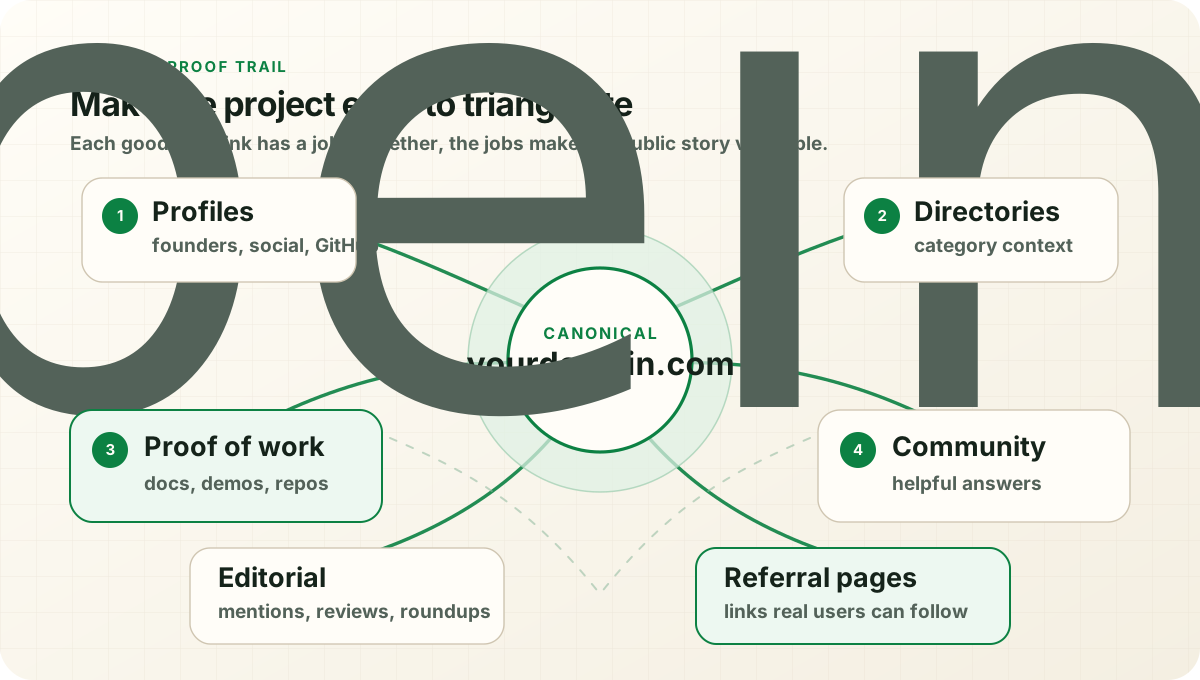
A good backlink profile does not just collect mentions. It fills the missing evidence roles around the project.
Do not build a pile. Build a pattern.
A pile of backlinks is just a spreadsheet with URLs in it. A pattern of backlinks tells a story.
For a small project, a useful pattern might look like this:
- Canonical links: profiles you control that clearly point to the main website. Think GitHub, LinkedIn, product profiles, portfolio pages, and founder pages.
- Category links: directories and databases where the project belongs because of what it does.
- Proof-of-work links: docs, demos, repositories, case studies, examples, templates, talks, or resources that prove the project is not vapor.
- Conversation links: useful answers and community posts where the link is a natural next step, not the whole point.
- Reference links: third-party mentions, roundups, partner pages, reviews, and editorial citations.
One weak link in each category can be more convincing than five strong-looking links from the same kind of place. Diversity is not just about domains. It is about the role each link plays.
This is where a directory like Backlink Badger is more useful as a decision tool than as a treasure map. The question is not only “which provider has high authority?” It is also “what gap in our public trail does this provider fill?”
Nofollow links are not worthless if you stop treating links as only votes
The vote metaphor makes nofollow links feel disappointing. If the link does not pass equity, why bother?
Because proof is not the same as equity.
A nofollow link can still be useful when it:
- sends qualified referral traffic;
- appears on a page that ranks for your category;
- connects your brand name to your canonical domain;
- helps humans verify that an account, founder, product, or resource is real;
- gives AI and search systems another public clue about the entity.
This does not mean every nofollow link is worth chasing. A dead profile on a spammy site is still a dead profile on a spammy site. But a relevant nofollow link in a page people actually read can be more useful than a technically dofollow link nobody will ever trust.
The link attribute matters. The context matters more.
Cute test: imagine your best customer found this link while half-awake with coffee in hand. Would it make them nod, or would it make them squint?
The best backlinks look like they would still exist if search engines disappeared
This is the cleanest test I know.
Before creating a backlink, ask: would this page still make sense if Google did not exist?
A company profile on a relevant database: yes. A tutorial that links to the tool it uses: yes. A founder profile with the company website: yes. A helpful answer that includes a resource: yes. A random signature link under a thin comment: probably not.
This test keeps you honest because it forces the link to have a non-SEO reason to exist. It also makes the work more durable. Search policies change. AI answer engines change. Platforms change link attributes. But useful public references tend to survive longer than obvious link litter.
A practical backlink audit for this model
Open your current backlink sheet and add one column: job.
For each link, choose one primary job:
- identity confirmation;
- category relevance;
- referral traffic;
- authority signal;
- social proof;
- proof of work;
- community presence;
- press or editorial reference.
Then look at the distribution. Most weak backlink strategies are lopsided. They have twenty identity links and no proof-of-work links. Or ten directory links and no conversation links. Or a few strong editorial mentions but no clean canonical profiles.
The fix is not always “more links.” Often it is a missing kind of link.
After that, score each opportunity with four practical questions:
- Can we create something useful there without pretending?
- Will the surrounding page make our project easier to understand?
- Is the risk low enough for the brand?
- Is the time investment proportional to the link’s job?
That last question matters. Spending two hours on a modest profile link may be silly. Spending two hours on a page that can rank, refer customers, and explain your category may be cheap.
The quiet advantage
A lot of SEO work is loud. Outreach campaigns, guest post negotiations, link exchanges, paid insertions, and endless prospecting all create motion.
The quieter advantage is building a public trail that makes your project obvious.
Obvious to search engines. Obvious to AI systems. Obvious to customers checking whether you are real. Obvious to journalists looking for context. Obvious to partners deciding whether you belong in the category.
That is not as exciting as a secret backlink trick. It is better. A coherent backlink footprint compounds because every new good link makes the next mention easier to understand.
So yes, backlinks still matter. But the better question is no longer “how many votes can we collect?”
The better question is: “what would a stranger be able to prove about us from the public web?”