
How to get a backlink from Dev Resources?
Dev Resources works as a backlink source when your site is a genuine resource for developers. The backlink comes from an accepted public resource page that stores your submitted url and links visitors to that website.
Steps
- Check that your resource is highly related to programming or development and is not already listed on Dev Resources.
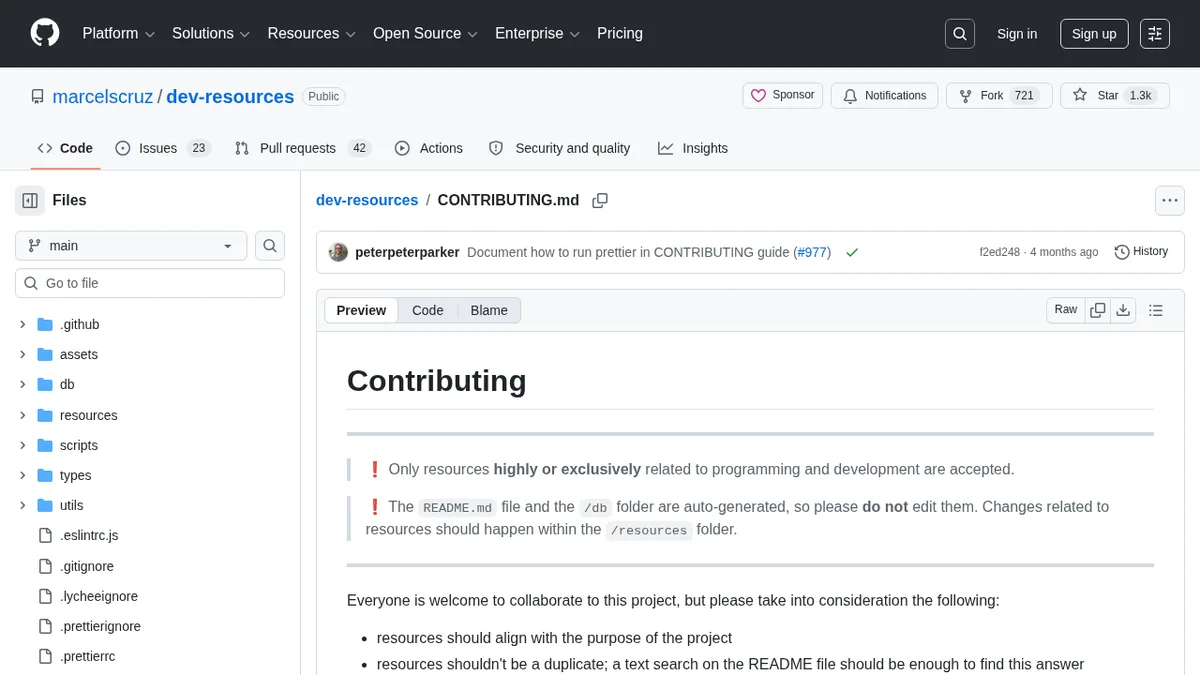
- Open the Dev Resources GitHub repository and read the contribution rules before editing.
- Add your resource to the correct alphabetical TypeScript file under the repository’s
resourcesfolder. The entry needs aname,description,categories,url, and optionalkeywords.
- Keep the resource in alphabetical order, use an accepted category, and make sure the URL starts with
https://orhttp://. - Run the repository’s formatting or checks if you can, then open a pull request and complete the checklist.
- After approval and publication, confirm the public resource page links to the correct canonical URL.
Example: the VeilStrat page on Dev Resources stores https://veilstrat.com as the resource URL and the rendered page includes an ordinary external link with rel="noopener" rather than nofollow.
Use this only for resources that genuinely help developers. A thin landing page submitted only for SEO is unlikely to pass review and would not be a durable citation.
Backlink signals
Editorial estimates for comparing this provider.
- Dofollow linksCan pass equityWe set this after checking whether the recommended backlink method on this provider typically outputs a dofollow link in the page HTML. If attributes vary by page type, we use the realistic default for that path and explain the nuance in the guide.
- Yes. We set this after checking whether the recommended backlink method on this provider typically outputs a dofollow link in the page HTML. If attributes vary by page type, we use the realistic default for that path and explain the nuance in the guide.
- Backlink valueEditorial estimateBacklink value is our 0-100 editorial estimate of how much authority a page you create here would actually carry. We score the page you would end up with - not the provider homepage - from how strongly the platform links to and indexes that page type, how much editorial review stands behind it, and what comparable pages are worth in practice. Most new pages anywhere are worth little; a few platforms hand a fresh page real strength straight away. It is a comparison estimate, not a measurement, and it will not match any third-party tool.
- 5/100. Backlink value is our 0-100 editorial estimate of how much authority a page you create here would actually carry. We score the page you would end up with - not the provider homepage - from how strongly the platform links to and indexes that page type, how much editorial review stands behind it, and what comparable pages are worth in practice. Most new pages anywhere are worth little; a few platforms hand a fresh page real strength straight away. It is a comparison estimate, not a measurement, and it will not match any third-party tool.
- Spam ratingLower is betterWe use spam score when we have a defensible value for the relevant domain or surface, otherwise a conservative Backlink Badger editorial estimate from platform quality and spam patterns. Treat it as an approximate comparison guide, not a guarantee of how search engines evaluate the site.
- 1/100. We use spam score when we have a defensible value for the relevant domain or surface, otherwise a conservative Backlink Badger editorial estimate from platform quality and spam patterns. Treat it as an approximate comparison guide, not a guarantee of how search engines evaluate the site.
- Acquisition difficultyLower is easierBacklink Badger assigns this 0–100 score from editorial review of signup friction, content requirements, approval gates, and account trust for the recommended path. It is an approximate comparison estimate, not a measured difficulty metric.
- 55/100. Backlink Badger assigns this 0–100 score from editorial review of signup friction, content requirements, approval gates, and account trust for the recommended path. It is an approximate comparison estimate, not a measured difficulty metric.
- Time estimateTypical setupWe estimate the minimum minutes a prepared user needs to sign up, set up, and publish or submit the backlink, including obvious waiting steps we can reasonably predict. This Backlink Badger estimate is approximate - your first attempt or extra verification may take longer.
- ~45 min. We estimate the minimum minutes a prepared user needs to sign up, set up, and publish or submit the backlink, including obvious waiting steps we can reasonably predict. This Backlink Badger estimate is approximate - your first attempt or extra verification may take longer.
- Free optionNo required spendWe mark Yes when the recommended backlink path can be completed without paying the provider for access, placement, or a required plan. If only paid tiers unlock the link, or payment is commonly required in practice, we mark No.
- Yes. We mark Yes when the recommended backlink path can be completed without paying the provider for access, placement, or a required plan. If only paid tiers unlock the link, or payment is commonly required in practice, we mark No.
- Linking domainsExternal signalWhen shown, this optional count comes from SEO research on the provider or relevant backlink surface and is rounded with a ~ prefix on the page. It is a Backlink Badger estimate for comparison and may be outdated or imprecise versus live crawlers.
- ~1,500. When shown, this optional count comes from SEO research on the provider or relevant backlink surface and is rounded with a ~ prefix on the page. It is a Backlink Badger estimate for comparison and may be outdated or imprecise versus live crawlers.
- Ranking keywordsExternal signalWhen shown, this count reflects researched ranking-keyword data for the provider domain or surface, displayed as an approximate ~ value. Treat it as a Backlink Badger comparison estimate that can drift as indexes and rankings change.
- ~9,000. When shown, this count reflects researched ranking-keyword data for the provider domain or surface, displayed as an approximate ~ value. Treat it as a Backlink Badger comparison estimate that can drift as indexes and rankings change.
- Inbound linksExternal signalWhen shown, this is an optional researched count of inbound links to the provider or relevant surface, formatted as an approximate estimate. Backlink Badger includes it only when defensible - it is not live-crawled data.
- ~12,000. When shown, this is an optional researched count of inbound links to the provider or relevant surface, formatted as an approximate estimate. Backlink Badger includes it only when defensible - it is not live-crawled data.
- Outbound linksExternal signalWhen shown, this optional count estimates outbound links from pages on the provider domain to other sites, included only when researched and defensible. It is a Backlink Badger approximate comparison figure, not a real-time crawl.
- ~25,000. When shown, this optional count estimates outbound links from pages on the provider domain to other sites, included only when researched and defensible. It is a Backlink Badger approximate comparison figure, not a real-time crawl.
Provider overview
Dev Resources is a curated, community-maintained directory of programming, design, API, hosting, productivity, and developer-tool resources. Accepted submissions get a public resource detail page that can point to the submitted project's canonical URL, making it useful for legitimate developer products and educational resources that fit the directory.
Minimum requirements to get a backlink from Dev Resources
- GitHub account
- Submit a real developer-focused website, tool, API, template, course, or resource that belongs in the directory
- Prepare the resource's name, clear description, category, canonical URL, and any useful search keywords
- Ability to edit TypeScript files and open a pull request
Key challenges to get a backlink from Dev Resources
Dev Resources is moderated through its GitHub repository, so a backlink requires a real developer-focused resource, a correctly formatted TypeScript entry, and an accepted pull request. Submissions must not be duplicates and should fit one of the site's resource categories. The public resource page links out to the submitted URL, but low-quality or promotional-only entries can be rejected during review.